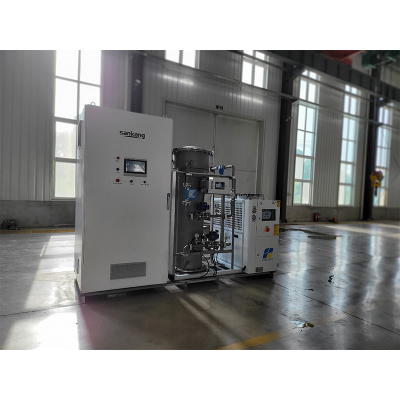
Application of Sankang Ozone Generator in VOCs Treatment
1. Technical Principle
Ozone removes VOCs through two main mechanisms:
Direct oxidation: Ozone molecules directly attack unsaturated bonds in VOCs (such as carbon-carbon double bonds and benzene rings), breaking them down into smaller molecules. This works well for alkenes and phenols.
Hydroxyl radical oxidation: With catalysts or UV light, ozone decomposes to form hydroxyl radicals (·OH). These have an oxidation potential of 2.80V, about 5 times that of ozone, and can non-selectively oxidize most VOCs into CO₂ and H₂O. Sankang Ozone Generator produces high-concentration ozone with stable output, ensuring efficient hydroxyl radical generation.
2. Main Advantages
Strong oxidation capacity, can mineralize most VOCs
Fast reaction, residence time minutes or less
No secondary pollution, end products are CO₂ and H₂O
Operates at room temperature and pressure
Can be combined with other treatment methods
3. Catalyst Types
| Catalyst Type | Features | Application |
|---|---|---|
| Manganese-based | Multiple valence states, high activity, low cost | Most common, suitable for medium-low concentration VOCs |
| Rare earth doped | High oxygen vacancy, good low-temperature activity | Hard-to-degrade VOCs, strict emission limits |
| Composite oxides | Synergistic effects, good stability | Complex gas components, continuous operation |
Common supports: activated carbon, molecular sieves, alumina. Catalyst life 2-3 years, regenerable by thermal or acid treatment.
4. Common Processes
Ozone catalytic oxidation: Waste gas enters reactor after pretreatment, mixes with ozone, passes through catalyst bed. Sankang Ozone Generator provides precise ozone dosage control for optimal oxidation efficiency.
Ozone dosage: 50-150 mg/L
Reaction time: 30-60 min
VOC removal: >90%, odor removal: >95%
Ozone-UV (O₃/UV): UV light increases hydroxyl radical production by 3-5 times. Suitable for hard-to-degrade VOCs.
Ozone-biological treatment: Ozone breaks down large VOC molecules into smaller ones for subsequent biological treatment. Reduces overall operating cost by >30%.
5. Application Example
Pesticide plant wastewater treatment station off-gas
Components: Non-methane hydrocarbons, formaldehyde, H₂S, etc.
Process: Two-stage ozone catalytic oxidation using Sankang Ozone Generator
Results:
Non-methane hydrocarbons: 500 → 30 mg/m³ (92.98% removal)
Formaldehyde: 10 → 0.5 mg/m³ (92.27% removal)
Odor: 6000 → 250 (93.83% removal)
Operating cost: 93.5 RMB/10,000 m³ gas
6. Applicable Industries
Petrochemical, fine chemical
Printing, painting, coating
Pharmaceutical, fermentation
Wastewater treatment, waste transfer stations
Electronics, semiconductor
Rubber, plastics
7. Outlook
Ozone catalytic oxidation technology is moving toward higher efficiency at lower temperatures, longer catalyst life, and smarter control. With reliable equipment like Sankang Ozone Generator, it will continue to provide cost-effective solutions for industrial VOC treatment.
Contact
For VOC treatment needs, contact our technical team for customized solutions with Sankang Ozone Generator.