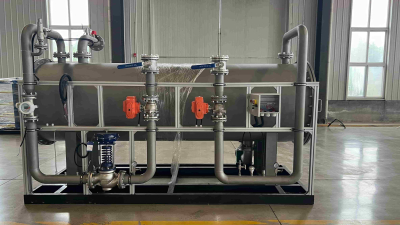
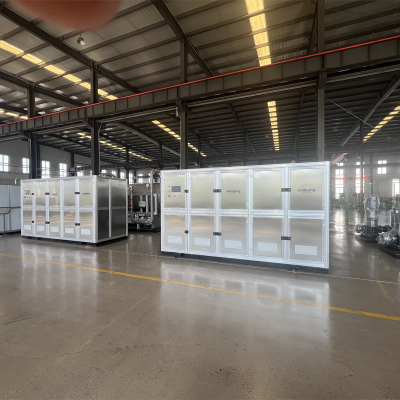
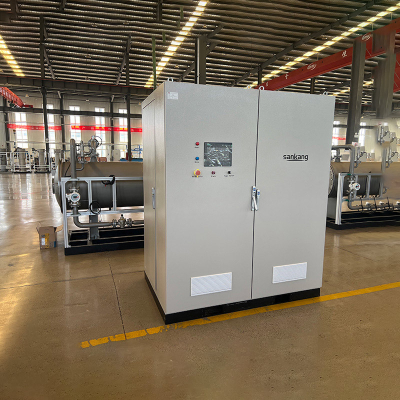
SanKang Ozone Generator for Flue Gas Desulfurization and Denitrification
1. Overview of SanKang Ozone-Based DeSOx & DeNOx Technology
With increasingly stringent global emission regulations, conventional flue gas desulfurization and denitrification technologies are facing limitations such as high capital investment, complex system design, and large installation footprint. Leveraging years of experience in ozone generation and environmental engineering, SanKang has developed an ozone-based advanced oxidation solution for efficient and reliable flue gas treatment.
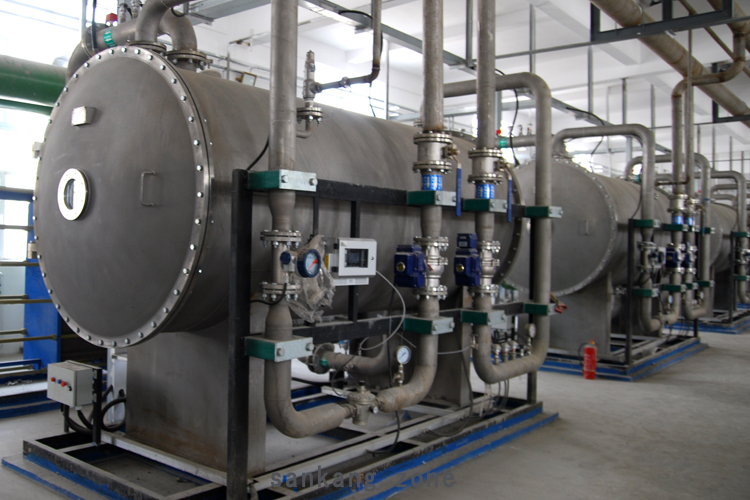
The core principle of SanKang’s ozone generator denitrification technology is to utilize the strong oxidative capability of ozone (O₃) to rapidly oxidize nitric oxide (NO), which is difficult to remove by conventional methods, into nitrogen dioxide (NO₂) and higher-valence nitrogen oxides (NOₓ). These oxidized species are then easily absorbed by water or alkaline solutions, achieving high-efficiency NOₓ removal.
2. Key Advantages of SanKang Ozone Denitrification Technology
Compared with traditonal DeNOx processes, SanKang ozone generator offer several significant advantages:
Strong oxidation and fast reaction kinetics
Ozone rapidly oxidizes NO without the need for catalysts or complex reaction conditions.
Simple process and high system integration
The system can be easily integrated with existing wet scrubbers or desulfurization units, reducing additional equipment investment.
Excellent performance under low-temperature conditions
Ozone remains highly effective below 150°C, making the technology especially suitable for low-temperature or tail-end flue gas treatment.
Simultaneous multi-pollutant removal
In addition to NOₓ, ozone can also assist in the removal of SO₂, elemental mercury (Hg⁰), and other hazardous pollutants, improving overall emission control efficiency.
3. Oxidation Mechanism and Technical Foundation
Extensive research has demonstrated that ozone reacts with NOₓ through complex chemical pathways. Studies conducted by researchers from Zhejiang University established a detailed reaction mechanism involving more than 65 reaction steps between O₃ and NOₓ, providing strong theoretical support for ozone-based denitrification.
In practical engineering applications, SanKang systems focus on key low-temperature oxidation reactions, ensuring efficient NO oxidation within a short residence time. The main reactions include:
NO + O₃ → NO₂ + O₂
NO₂ + O₃ → NO₃ + O₂
NO₃ + NO₂ → N₂O₅
4. Performance and Engineering Application Results
Experimental studies and engineering practices have shown that under typical flue gas conditions:
NO oxidation efficiency exceeds 84%
When combined with downstream wet scrubbing, SO₂ removal efficiency approaches 100%
At an O₃/NO molar ratio of approximately 0.9, DeNOx efficiency reaches 85–90%
Through precise control of ozone dosage, reaction temperature, and residence time, SanKang ozone systems achieve high removal efficiency while minimizing ozone consumption and operating costs.
5. Key Operating Parameters and System Optimization
5.1 O₃/NO Molar Ratio Control
SanKang adopts a modular ozone generation system with intelligent control, enabling accurate matching of ozone dosage to NO concentration and stable operation within the optimal O₃/NO range of 0.9–1.0.
5.2 Temperature Adaptability
SanKang ozone DeNOx solutions are particularly suitable for low-temperature flue gas sections, where ozone stability and oxidation efficiency remain high.
5.3 Absorption System Compatibility
Depending on site conditions, SanKang systems can be flexibly combined with NaOH, Ca(OH)₂, or other alkaline absorption solutions, allowing seamless integration with existing desulfurization or washing towers.
6. Application Fields and Value Proposition
With mature ozone generation technology, reliable system integration, and extensive project experience, SanKang ozone-based DeSOx and DeNOx solutions are widely applicable in:
Waste-to-Energy (WTE) plants
Industrial boilers and furnaces
Chemical and metallurgical industries
Low-temperature flue gas retrofit and deep DeNOx projects
SanKang is committed to delivering efficient, reliable, and sustainable ozone solutions that help customers meet increasingly stringent environmental emission standards.